Email:alexander@dayiforgingtech.cn
Language: 



The 8000-ton fast forging hydraulic press is a heavy-duty metal forming machine designed for open-die forging of large workpieces. It is commonly used in sectors such as aerospace, power generation, marine engineering, and petrochemicals. Typical forged parts include large shafts, rings, cylinders, and blocks.
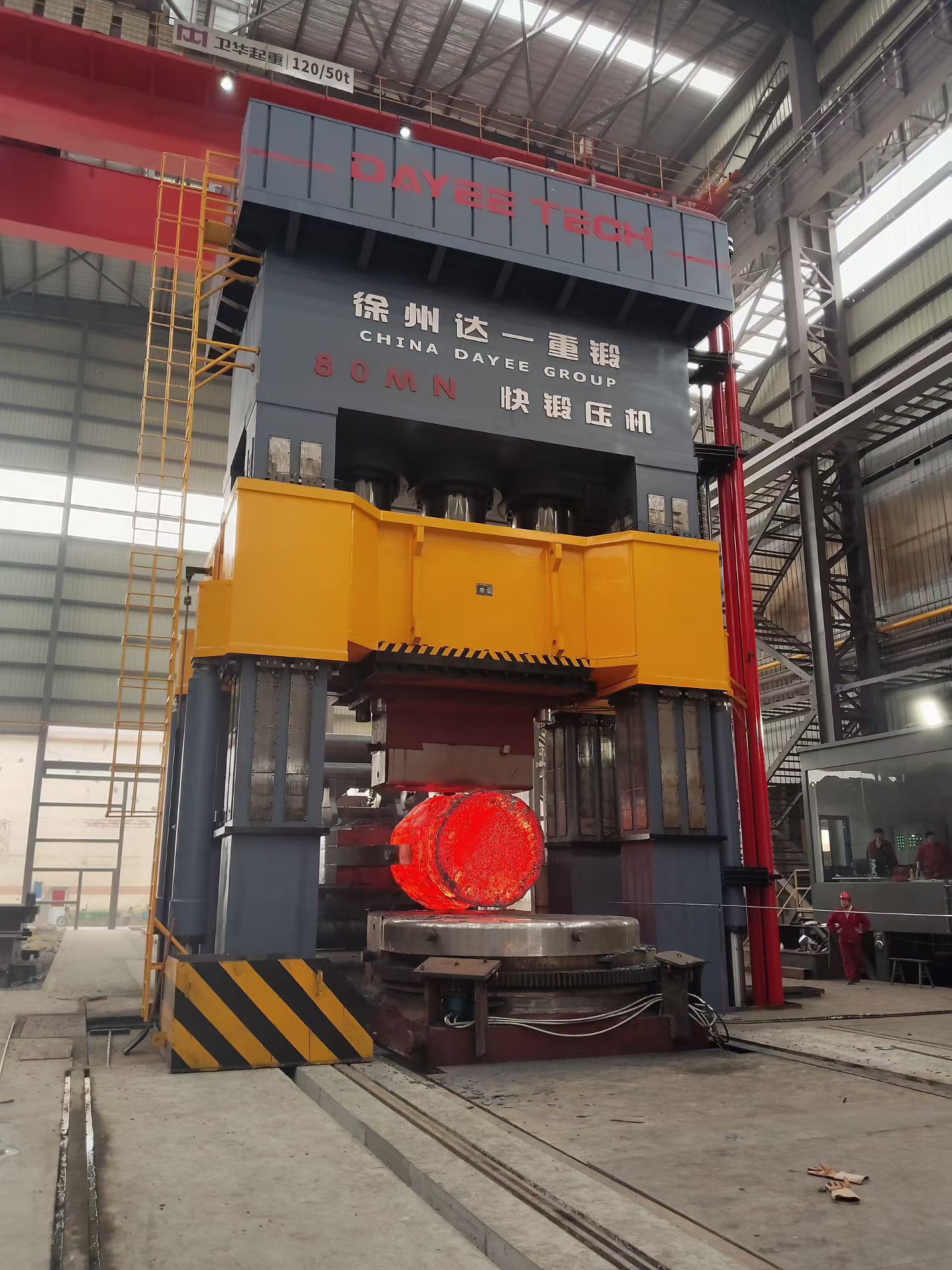
The press is rated at a nominal force of 80 MN (approximately 8000 metric tons). The clear height between the moving platen and the table is typically between 3500 mm and 4500 mm, depending on the workpiece size. The table size is often 4000 mm × 6000 mm or larger. Forging force control accuracy can reach within ±3%.
The press mainly consists of the main frame, main working cylinders, return cylinders, moving table, hydraulic power unit, electrical control system, and a forging manipulator. The main frame can be either a three-beam, four-column type or a pre-stressed wire-wound type. The wire-wound design offers better fatigue life and overall rigidity. The moving table allows quick die changes, reducing downtime.
"Fast forging" means the press can perform repeated forging strokes in a short period. An 8000-ton fast forging press is equipped with proportional servo valves and accumulator groups. The idle stroking speed can reach 250 mm/s; the working speed is adjustable between 40–80 mm/s, and the return speed is around 200 mm/s. When combined with a forging manipulator, the press can automate processes such as feeding, flattening, drawing out, and upsetting. The cycle time per stroke is typically 3–5 seconds.
The machine uses PLC and industrial computer for two-level control. Operators set the forging program through a touchscreen or HMI, including reduction amount, number of strokes, and speed profile. The system includes a forging process database that supports recall of programs for different part types. Closed-loop control is achieved with displacement and pressure sensors, ensuring dimensional accuracy of the forged parts.
Large rotor shafts and wind turbine main shafts
High-pressure vessel shells and nuclear main pipelines
Marine crankshafts and large gear blanks
Difficult-to-deform materials such as titanium alloys and superalloys
The press is shipped in sections and assembled on site by welding or bolting. The hydraulic system includes filtration and cooling to keep oil temperature below 55°C during continuous operation. Routine maintenance includes changing filter elements, inspecting high-pressure hoses and seals, and checking rod preload. Mean time between failures (MTBF) is typically above 6000 hours.
The 8000-ton fast forging hydraulic press provides a reliable solution for forming large open-die forgings. Its fast forging function improves production efficiency, reduces the number of reheating cycles, and saves energy. When selecting such a press, buyers should discuss technical details with the manufacturer based on specific material types, part sizes, and production volumes.
Contact: Mr. Alexander King
Phone: +86 17621575373
Tel: +86 17621575373
Email: alexander@dayiforgingtech.cn
Whatsapp:+86 17621575373
Add: Room 1-124, Changkai Building, Gulou District, Xuzhou City, Jiangsu Province, China
We chat
