Email:alexander@dayiforgingtech.cn
Language: 



In the aerospace, medical device, and high-end equipment manufacturing fields, titanium alloys are critical materials due to their high strength, excellent corrosion resistance, and high-temperature performance. However, their narrow forging window, high deformation resistance, and extreme sensitivity to temperature pose stringent demands on forging hydraulic presses, far exceeding those for ordinary steel. Selecting a suitable hydraulic press is crucial for ensuring the performance of forged parts, production efficiency, and return on investment.
Introduction to Titanium Alloys:
They possess extremely high specific strength, excellent corrosion resistance, and biocompatibility.
α and near-α alloys (e.g., Ti-3Al-2.5V): Good creep strength and weldability.
α+β alloys (e.g., Ti-6Al-4V, the most commonly used): Offer a good balance of strength, toughness, and hot workability. Used in aircraft engine compressor discs/blades, aircraft frames, and biomedical implants.
β alloys (e.g., Ti-10V-2Fe-3Al): Higher strength, deep hardenability, and cold formability.
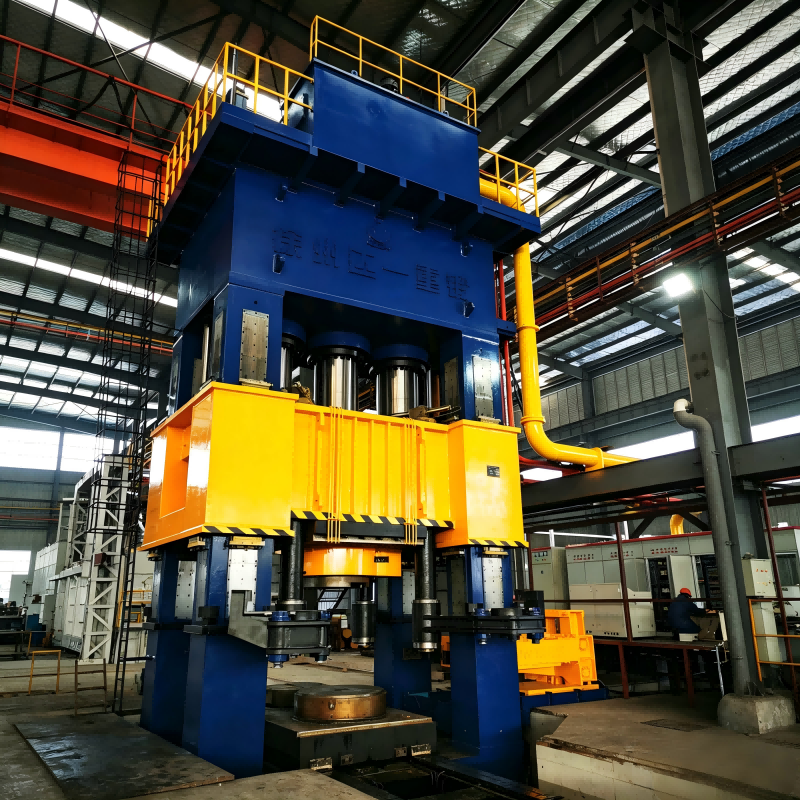
1: Understanding the Four Core Challenges of Titanium Alloy Forging
Material selection begins with process understanding. The key challenges of titanium alloy forging directly determine equipment requirements:
Narrow hot working window: The forging temperature range is typically only 100-150°C, requiring precise temperature control and rapid operation to prevent cracking or uneven microstructure.
Extremely high deformation resistance and flow stress: Even at high temperatures, the unit pressure required for deformation is 20%-50% higher than that of alloy steel, requiring equipment with extremely high rigidity and sufficient tonnage capacity.
Strong strain rate sensitivity: The deformation speed directly affects its microstructure and mechanical properties, requiring the press to have a wide and precisely controllable speed adjustment capability.
Complex precision isothermal/near-isothermal forging process: Many high-end forgings (such as integral blisks) require low-speed forming in constant-temperature molds, which requires the equipment to integrate a precise mold heating and temperature maintenance system.
2: Five Key Technical Parameters for Hydraulic Press Selection
Based on the challenges mentioned above, the following is a matrix of technical parameters that must be verified during the selection process:
| Selection Criteria/Dimensions | Key parameter requirements | The significance of titanium alloy forging |
| 1. Pressure and rigidity | Nominal tonnage: Calculated value × 1.5 times or more safety factor Frame structure: Prestressed frame or integral welded frame | To cope with extremely high deformation resistance, ensure dimensional accuracy, and prevent forging defects caused by machine body deflection. |
| 2. Speed and Control | Idle/return speed: ≥300 mm/s Working speed control: Servo proportional valve or direct servo pump control, infinitely variable and precise adjustment. | Shorten the heat exposure time, precisely match the process curve, and control the strain rate to optimize material properties. |
| 3. Itinerary and Space | Maximum stroke: Designed to accommodate multi-stage processes such as upsetting and drawing. Opening height and table dimensions: Suitable for large molds and insulation covers. | It meets the spatial requirements for complex forgings and multi-stage operations, and provides interfaces for automated loading and unloading. |
| 4. Accuracy and Synchronization | Slider parallelism: ≤0.1 mm/m (National Standard Grade A) Position repeatability: ≤±0.2 mm | Ensuring the consistency of complex and precision forged parts is a strict requirement for the certification of critical components such as those used in aircraft engines. |
| 5. Temperature integration capability | Workstation/slider heating interface: Standardized through-hole or quick-change interface Control system compatibility: Can be integrated with mold temperature control modules | Achieving isothermal/near-isothermal forging processes unlocks the capability to form high-end forged parts. |
3: Essential and Optional Features of the Hydraulic System and Configuration
Core "Essential" Configurations:
High-response servo hydraulic system: Achieves precise closed-loop control of pressure and speed, forming the foundation for meeting the sensitive process curves of titanium alloys.
High-efficiency water or oil cooling system: The hydraulic system generates significant heat during forging; powerful cooling capabilities are essential for continuous and stable operation.
Multi-point ejection system: Facilitates demolding of complex forgings and can also serve as an auxiliary forming too.
Forging-specific operating system: Pre-configured forging process packages, with process parameter recording and traceability functions, meeting aerospace quality system requirements.
Upgraded "Optional" Configurations:
Remote monitoring and diagnostics: Enables preventative maintenance and reduces unplanned downtime.
Force-displacement-time data acquisition and analysis: Provides data support for process optimization and quality traceability.
Interface for linkage with robots/manipulators: The first step towards automated and less labor-intensive forging production lines.
4: Selection Decision and Supplier Evaluation Checklist
When making specific decisions, please follow these steps and conduct a thorough evaluation:
1. Define the process baseline: List the typical forgings planned for production (material grade, projected area, target process type).
2. Calculate tonnage requirements: Use professional formulas and ensure sufficient safety margins.
3. Develop specifications: Translate the aforementioned "five key parameters" and "essential configurations" into procurement technical specifications.
4. In-depth supplier evaluation:
l Technical capabilities: Does the supplier have successful application cases of isothermal forging of titanium alloys? Request videos or on-site visits.
l Core components: Are the main cylinder, servo system, seals, etc., from world-class brands (such as Bosch Rexroth, Parker, Moog, etc.)?
l Software and control: Is the operating system open, user-friendly, and scalable?
l Local service: Can the supplier provide rapid on-site technical support and spare parts supply?
Choosing a titanium alloy forging hydraulic press is essentially about procuring the most robust, intelligent, and precise industrial tool for the most demanding processes. It should not be viewed as a simple fixed asset purchase, but rather as a strategic investment aimed at enhancing core technological capabilities and pushing the boundaries of manufacturing processes. Within budget constraints, prioritizing the three core pillars of "rigidity, control precision, and temperature integration" is essential to forging the titanium structures that will conquer the future.
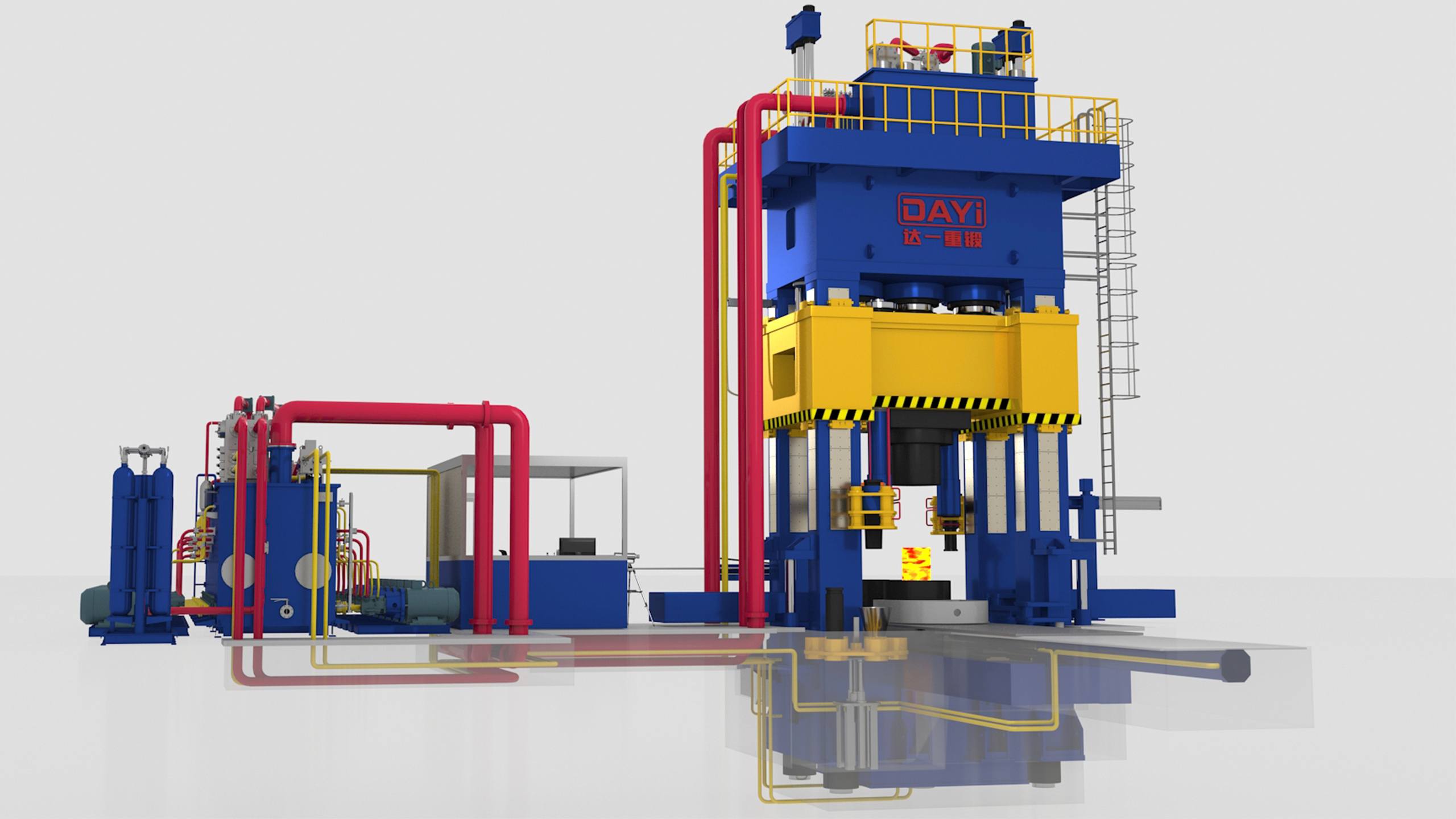
DAYI heavy forging technology located in the famous capital of heavy industry in China, Xuzhou city. After years of development and integration, has grown into the domestic industrial automation equipment industry star. Our press are mainly used in shafts for ship engines and power station turbines, or flawless and reliable components for aerospace applications,satisfying various forging technical requirements, such as upsetting, drawing out, piercing, saddle forging, bending, offset forging, etc. finished +20000 sets Delivery, served +2000 customers.
Our heavy hydraulic alloys forging Machine support customized 300~30000 tons for demand from aerospace, Electric vehicles, ships, high-speed rail, wind power, nuclear energy, composite, Ti alloy forging, household appliances, general industrial forging.Welcome to our factory for a visit.
Contact: Mr. Alexander King
Phone: +86 17621575373
Tel: +86 17621575373
Email: alexander@dayiforgingtech.cn
Whatsapp:+86 17621575373
Add: Room 1-124, Changkai Building, Gulou District, Xuzhou City, Jiangsu Province, China
We chat
