Email:alexander@dayiforgingtech.cn
Language: 



In the manufacturing of aircraft engine turbine disks, spacecraft hot-end components, and high-performance energy equipment, nickel-based superalloys are undoubtedly the "king of materials." Their exceptional high-temperature strength, creep resistance, and oxidation resistance make them the ideal choice for extreme environments. However, forging this "king of difficult-to-deform alloys" is the ultimate test of a hydraulic press's overall performance.
Nickel-based superalloys
These alloys possess excellent strength, oxidation resistance, and creep resistance at high temperatures (above 600°C). They are core materials for hot section components of aircraft engines and gas turbines.
Wrought superalloys (such as Inconel 718, Inconel 625): These can be formed through processes such as forging and rolling. They are used in turbine discs, blades, and ring components.
1.Understanding the Challenges–Forging Characteristics of Nickel-Based Superalloys
Material selection begins with a deep understanding of the process difficulties. Forging nickel-based superalloys faces three core challenges, which directly determine the equipment requirements:
·Extremely high deformation resistance and a narrow process window: Even at ultra-high temperatures above 1100°C, the flow stress remains enormous, and the forging temperature range is narrower than that of titanium alloys. This requires the hydraulic press to have extremely high and stable tonnage output and to perform fast and precise operations to avoid cracking risks caused by temperature drops.
·Extreme sensitivity to strain rate: Small changes in deformation speed significantly affect recrystallization behavior and final mechanical properties. To achieve a uniform, fine-grained microstructure, precise closed-loop control of the forging speed at the millisecond level is essential.
·Complex multi-pass, multi-stage forming processes: Critical components such as turbine disks typically require multiple heating, upsetting, punching, and ring expansion processes. This requires the hydraulic press to be not only an execution unit but also a highly flexible and programmable process platform.
2: Core Selection Criteria
Based on the challenges mentioned above, your selection checklist must focus on the following five dimensions, all of which are essential:
Selection Criteria/Dimensions | Core technical requirements | The significance of forging nickel-based alloys |
1. Pressure tonnage and frame rigidity | Nominal tonnage: Theoretical calculated value × safety factor of 2.0 or higher. It is recommended to start the evaluation from 4000 tons and above. Frame structure: The preferred options are a monolithic prestressed steel wire wound frame or a heavy-duty multi-layer thick plate welded frame. | Ensuring formability under extreme deformation resistance and completely eliminating fuselage deflection are crucial for guaranteeing the dimensional accuracy and structural uniformity of ultra-large forgings. |
2. Precise speed and pressure contro | Control system: A fully closed-loop servo hydraulic system must be used (such as pump-controlled servo or high-performance proportional servo valve control). Speed control accuracy: Precise and stable control with an accuracy of ±1% can be achieved within the working speed range of 0.1-20 mm/s. | By precisely matching the material's strain rate-temperature curve, controlled dynamic recrystallization can be achieved, resulting in the desired excellent high-temperature mechanical properties. |
3. Extra-large workspace and travel range | Opening height and table dimensions: Sufficient space must be provided for the installation of special processes such as oversized molds, insulation covers, and ceramic fiber blankets. Stroke: Sufficient stroke is required to support large deformation processes such as multi-pass upsetting and punching. | It is designed to adapt to complex, multi-step forging processes and includes interfaces for automated auxiliary equipment (such as robotic arms and rotary tables). |
4. Excellent thermal management and compatibilit | Heat-resistant design: The slider and workbench must have an efficient thermal insulation and cooling channel design to prevent heat transfer from damaging the main cylinder seal. Control compatibility: The PLC must be able to seamlessly integrate signals from multi-zone mold heating furnaces and infrared thermometers to achieve coordinated control. | It directly withstands mold environments exceeding 1200°C, ensuring the long-term stable operation of the equipment and supporting top-tier processes such as isothermal/near-isothermal forging. |
5. Data traceability and process reproducibility capabilities | Data acquisition: The system must be able to record and store pressure, displacement, speed, and time curves at high frequency throughout the entire process. Process management: Supports storing successful forging parameters as "process packages" for one-click recall, ensuring consistency for every product. | Meeting the most stringent quality traceability requirements in the aerospace industry (such as material pedigree) is crucial for product certification. |
3. Beyond the Equipment – System Integration and Supplier Evaluation
A qualified hydraulic press should be the core of an intelligent forging unit. Your evaluation should extend to:
·Automation Integration Interface: Evaluate whether its communication interfaces with equipment such as high-temperature robots, vision alignment systems, and laser rangefinders (e.g., Profinet, Ethernet/IP) are open and standardized.
·Core Component Brands: Are the main pump, servo valves, sensors, and PLC from top brands such as Rexroth, Moog, and Siemens? This directly determines the reliability and lifespan of the system.
·Supplier's "Process Partner" Capabilities: The best suppliers are not only equipment manufacturers but also forging process experts. Do they have successful forging cases of nickel-based alloys (e.g., Inconel 718, Waspaloy)? Can they provide full support from mold design to process debugging?
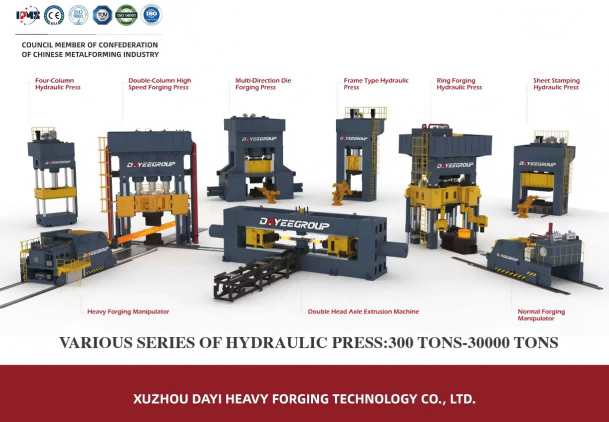
Selecting a hydraulic press for forging nickel-based superalloys is a performance-driven procurement process focused on achieving the highest possible standards. The core logic is to match the most rigid, intelligent, and reliable industrial equipment to the most complex and sensitive material processes. Within budget constraints, no expense should be spared to ensure top-tier configurations for the three core pillars: a rigid frame, full closed-loop servo control, and heat-resistant data traceability. This investment purchases not only metal forming capabilities but also a passport to enter the core value chain of high-end manufacturing, serving as the foundation for forging the future and driving innovation.
DAYI heavy forging technology located in the famous capital of heavy industry in China, Xuzhou city. After years of development and integration, has grown into the domestic industrial automation equipment industry star. Our press are mainly used in shafts for ship engines and power station turbines, or flawless and reliable components for aerospace applications,satisfying various forging technical requirements, such as upsetting, drawing out, piercing, saddle forging, bending, offset forging, etc. finished +20000 sets Delivery, served +2000 customers.
Our heavy hydraulic alloys forging Machine support customized 300~30000 tons for demand from aerospace, Electric vehicles, ships, high-speed rail, wind power, nuclear energy, composite, Ti alloy forging, household appliances, general industrial forging.Welcome to our factory for a visit.
Contact: Mr. Alexander King
Phone: +86 17621575373
Tel: +86 17621575373
Email: alexander@dayiforgingtech.cn
Whatsapp:+86 17621575373
Add: Room 1-124, Changkai Building, Gulou District, Xuzhou City, Jiangsu Province, China
We chat
